model/mrg-report-1.solv
[ pkmodel ] advan = 1

[ param ] CL = 1, V = 70

[ table ]

if(END_OF_INFUSION) mrg::report(A1/V);mrg::report()When debugging model code, it is sometimes helpful to write print statements at strategic locations to see what is happening during the model run.
In this example, we are infusing a dose over 2 hours and want to check the concentration at the end of the infusion. For simplicity, we’ll just print that value to the console.
model/mrg-report-1.solv
[ pkmodel ] advan = 1
[ param ] CL = 1, V = 70
[ table ]
if(END_OF_INFUSION) mrg::report(A1/V);mod <- mread("model/mrg-report-1.solv"). Building mrg-report-1_solv ... done.dose <- ev(amt = 100, tinf = 4)
out <- mrgsim(mod, dose). from report 1.38852The obvious downside to this approach is you can easily flood the console with outputs that are hard to make sense of. In that case, you can use a more controlled approach, saving each value you eventually want reported and then assigning those objects into the model environment. An example is shown here.
model/mrg-report-2.solv
[ plugin ] mrgx

[ global ]
std::deque<double> eof;

[ pkmodel ] advan = 1

[ param ] CL = 1, V = 70

[ table ]
if(NEWIND <= 1) eof.clear();

if(END_OF_INFUSION) eof.push_back(A1/V);

if(FINAL_ROW) {
  mrgx::assign("eof", eof, self);
}
mod <- mread("model/mrg-report-2.solv"). Building mrg-report-2_solv ... done.dose <- mutate(dose, ii = 24, addl = 3)
out <- mrgsim(mod, dose, end = 240, delta = 0.1)
out <- mutate_sims(out, CP = A1/mod$V)
plot(out, CP ~ time)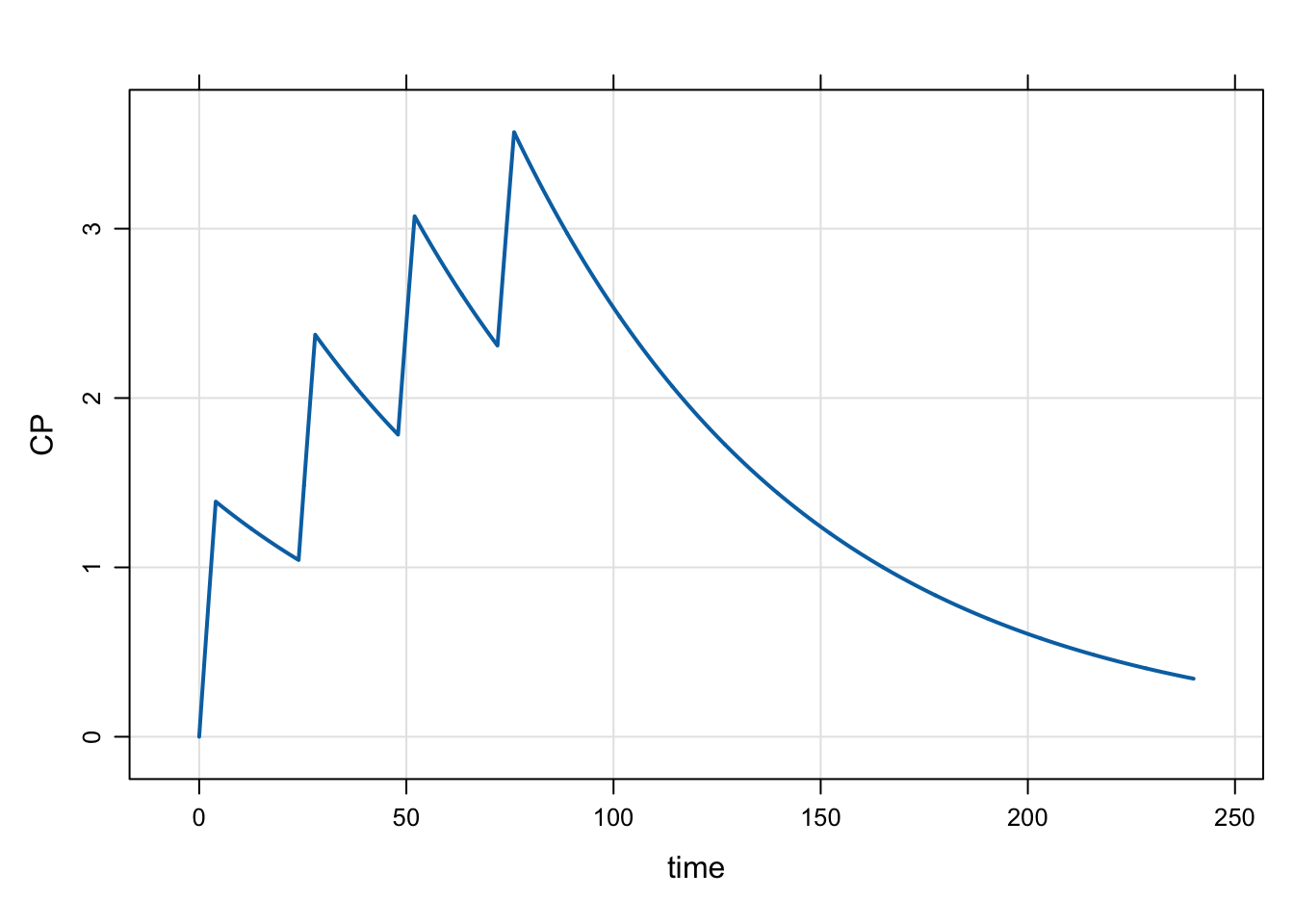
To pull the data from the model environment, you run:
env_get(mod, "eof"). [1] 1.388522 2.374010 3.073451 3.569871